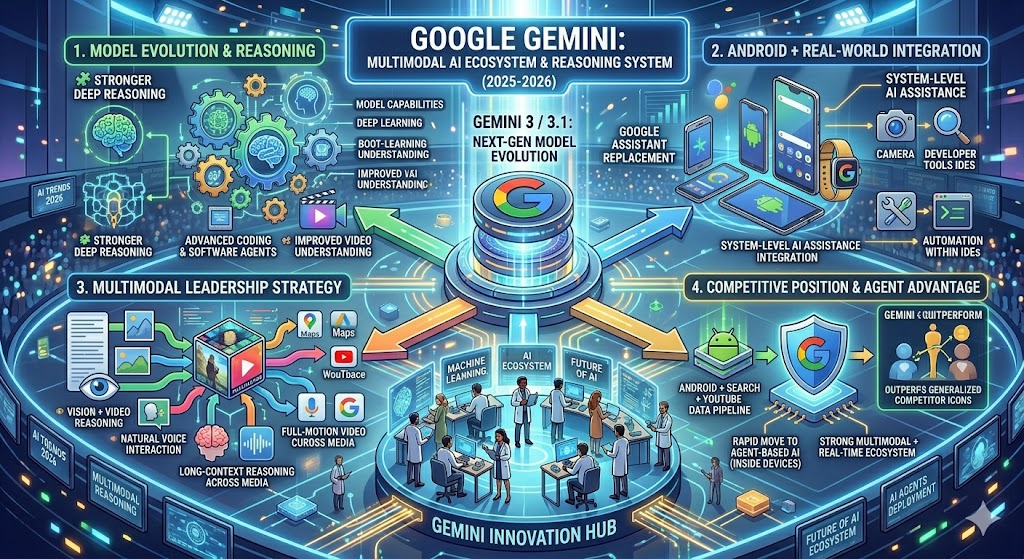
The tech industry is entering a new phase where AI is no longer a separate tool — it is becoming the core operating layer of devices, apps, and services. Google is leading this shift by deeply integrating its AI system, Gemini, across the entire Android and Google ecosystem.
📱 1. AI in Android Phones (Android 17 era)
Google is embedding Gemini directly into Android, turning smartphones into AI-first devices.
Key upgrades include:
- System-level AI assistant integration
- On-screen context understanding
- Cross-app task execution (no switching needed)
📌 Result: Phones are shifting from “app-based interaction” → to “AI-driven intent execution”
🚗 2. AI in Cars (Android Auto evolution)
In Android Auto, Gemini is enabling more natural and intelligent driving assistance:
- Voice-controlled navigation with real context
- Smart messaging and summarization while driving
- Predictive suggestions for routes, stops, and alerts
📌 Cars are becoming “AI co-pilots” instead of just infotainment systems.
🔍 3. AI in Search, Maps, and Daily Apps
Google is upgrading core services like:
- Google Search
- Google Maps
With Gemini integration:
- Search becomes conversational and task-based
- Maps can plan multi-step journeys automatically
- Apps begin to act as “AI agents” instead of static tools
📌 Users don’t just search — they delegate tasks.
💻 4. AI in Laptops & Devices (New hardware direction)
Google is also moving toward AI-native laptops (often referred to as “Googlebook-style” concepts):
- Built-in Gemini assistant at OS level
- Real-time automation across apps
- Deep integration with cloud + local AI processing
📌 The goal: devices that understand intent, not just commands.
⚙️ 5. Biggest Update: AI That Acts, Not Just Talks
The most important shift is this:
Gemini is evolving from a chatbot into an AI agent system that can:
- 📅 Book appointments
- 📝 Fill forms automatically
- 🔄 Execute workflows across multiple apps
- 🧠 Make context-aware decisions
📌 This marks the transition from “assistant AI” → to “action AI”
🔮 Conclusion
The industry is moving toward a future where AI becomes the default interface of computing. Instead of opening apps, users will simply state intent, and systems like Gemini will execute tasks across Android, Search, Maps, and connected devices.
This is not just an upgrade — it is a full transformation of how operating systems work.