

Ethical AI: Privacy, Bias, Safety, and Responsible Use of Technology 🤖⚖️
Artificial intelligence is becoming one of the most influential technologies of the modern era. AI systems are now used in education, healthcare, finance, transportation, customer service, entertainment, cybersecurity, scientific research, and many other areas of daily life.
The rapid development of AI creates enormous opportunities. Intelligent systems can analyze large amounts of information, automate repetitive tasks, assist professionals, support scientific discovery, and help people access information more efficiently.
However, greater technological capability also creates greater responsibility.
AI systems can affect people’s lives in significant ways. They may process personal information, influence decisions, generate content, recommend actions, or automate processes that were previously controlled entirely by humans.
This creates important ethical questions.
How should personal data be protected?
How can organizations reduce unfair bias?
Who is responsible when an AI system makes a harmful mistake?
How should AI be tested for safety?
When should humans remain in control?
These questions form the foundation of ethical AI.
Ethical AI is not about stopping technological innovation. It is about ensuring that AI is designed, developed, deployed, and used in ways that respect human rights, reduce unnecessary harm, promote fairness, and maintain appropriate human oversight.
🧠 What Is Ethical AI?
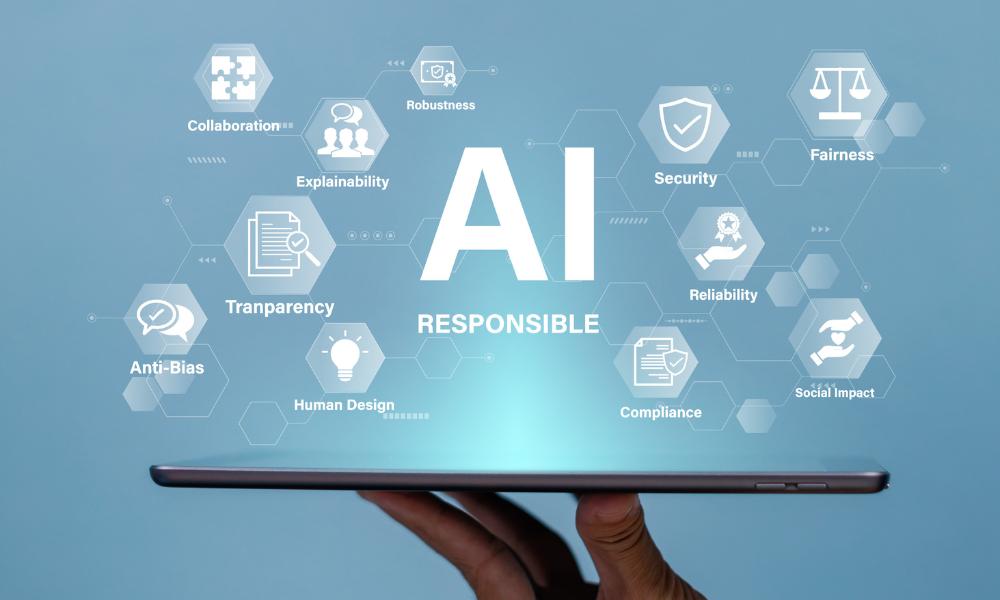
Ethical AI refers to the development and use of artificial intelligence according to principles such as fairness, privacy, transparency, accountability, safety, security, and respect for human dignity.
An AI system can be technically impressive while still creating ethical problems.
For example, an algorithm might make predictions with high accuracy but use personal information in ways people did not expect.
Similarly, an automated decision system might perform efficiently while producing systematically unfair outcomes for certain groups.
Ethical AI therefore requires organizations to consider not only whether a system works, but also how it works, whom it affects, and what consequences it may create.
🔐 1. Privacy and Personal Data
Privacy is one of the most important ethical issues surrounding AI.
AI systems often rely on large quantities of data. Depending on the application, this may include information about people’s behavior, preferences, communications, locations, purchases, education, health, or professional activities.
The ability to analyze large datasets can create valuable insights, but it can also create privacy risks.
People may not always understand how their information is collected, processed, stored, or shared.
🛡️ Protecting Personal Information
Responsible AI development should consider data protection from the beginning.
Organizations can reduce privacy risks by:
- Collecting only necessary information
- Limiting access to sensitive data
- Using appropriate security measures
- Clearly communicating data practices
- Providing meaningful privacy controls
- Retaining information only when necessary
- Reviewing how data is used
Privacy should not be treated as an afterthought.
It should be part of the design process.
📱 AI and Everyday Devices
Smartphones, wearable devices, smart-home systems, and online platforms can generate significant amounts of personal information.
As AI becomes more integrated into these technologies, users should understand what information is being processed.
Greater personalization can be convenient, but convenience should not require unlimited access to personal data.
⚖️ 2. Bias in Artificial Intelligence
Another major ethical concern is algorithmic bias.
AI systems learn patterns from data. If the training data contains historical biases, incomplete information, or unequal representation, an AI system can potentially reproduce or amplify those problems.
Bias can also arise from the way a system is designed, the objectives it is given, or the environment in which it is deployed.
🔎 Where Can Bias Appear?
AI bias can potentially affect areas such as:
- Hiring
- Lending
- Education
- Healthcare
- Advertising
- Facial recognition
- Insurance
- Customer service
- Automated decision-making
A biased system can produce unfair outcomes even when developers did not intentionally design it to discriminate.
🧪 Testing for Fairness
Organizations can evaluate AI systems using appropriate testing methods.
They can examine whether performance differs significantly across relevant groups and investigate why those differences occur.
However, fairness is not always represented by one simple mathematical measurement.
Different applications may require different definitions of fairness.
This makes ethical review an important part of AI development.
🧑⚖️ 3. Accountability and Responsibility
One of the most difficult questions in AI ethics is accountability.
If an AI system makes a harmful decision, who is responsible?
Is it the developer?
The company that deployed the system?
The person who approved the decision?
The organization that supplied the data?
AI should not become an excuse for avoiding responsibility.
Human beings and organizations remain responsible for how AI systems are designed and deployed.
👥 Human Oversight
For high-impact applications, human oversight can be essential.
People should have appropriate authority to review decisions, identify errors, intervene when necessary, and shut down or modify systems that create unacceptable risks.
The more significant the consequences of an AI decision, the more important meaningful human oversight becomes.
🛡️ 4. AI Safety
AI safety involves reducing the possibility that an AI system will behave in harmful or unexpected ways.
A system can fail because of incorrect data, software errors, poorly defined objectives, unexpected user behavior, or limitations in the underlying model.
Safety therefore requires testing before and after deployment.
🔬 Testing AI Systems
Responsible AI development may involve:
- Testing systems under normal conditions.
- Testing unusual or difficult scenarios.
- Identifying failure modes.
- Monitoring performance after deployment.
- Investigating reported problems.
- Updating systems when necessary.
AI safety is an ongoing process rather than a one-time certification.
🚨 5. AI and Misinformation
Generative AI can produce realistic text, images, audio, and video.
These capabilities can support creativity and communication, but they can also be used to create misinformation.
AI-generated content can potentially be used for:
- Fake news
- Impersonation
- Fraud
- Manipulated images
- Fake audio
- Misleading videos
- Automated propaganda
The increasing realism of synthetic media makes digital literacy more important.
🔍 Verifying Information
People should avoid assuming that realistic-looking content is automatically authentic.
For important information, users should consider:
- Who created the content?
- What evidence supports the claim?
- Is there an independent source?
- Is the information current?
- Could the content have been manipulated?
Responsible AI use requires responsible information consumption.
💻 6. Cybersecurity and AI
AI creates both cybersecurity opportunities and risks.
Security teams can use AI to identify unusual network activity, analyze large amounts of security information, and assist with threat detection.
At the same time, malicious actors may use AI to create more convincing phishing messages, automate scams, or increase the scale of certain attacks.
This creates an ongoing technological competition.
🔒 Building Secure AI Systems
AI developers should consider cybersecurity throughout the system lifecycle.
Important measures can include:
- Secure software development
- Access controls
- Authentication
- Monitoring
- Regular security testing
- Protection against data leakage
- Incident-response procedures
Security should be treated as a core requirement rather than an optional feature.
🧠 7. Transparency and Explainability
People may be uncomfortable with important decisions being made by systems they cannot understand.
Transparency can help build trust.
Users should know when they are interacting with AI where that information is relevant.
For high-impact systems, organizations may also need to provide meaningful explanations about how decisions are reached.
📊 Why Explainability Matters
Consider an automated system that recommends whether someone receives a particular service.
If the person is denied, they may reasonably want to understand why.
An explanation can help people identify errors, challenge unfair decisions, and understand how the system operates.
Not every AI system requires the same level of technical explainability, but important decisions should not become completely opaque.
👨💼 8. AI in the Workplace
AI is changing how people work.
Automation can increase productivity, but it can also change job responsibilities and create uncertainty for employees.
Some tasks may disappear or become automated, while new tasks and occupations emerge.
Responsible organizations should consider the human impact of AI adoption.
🧑🏫 Reskilling Workers
Instead of treating AI only as a way to reduce labor costs, organizations can invest in employee development.
Workers may need training in:
- AI literacy
- Digital tools
- Data analysis
- Critical thinking
- New technical skills
- AI-assisted workflows
Responsible AI adoption should consider how technology can help workers become more productive rather than simply viewing people as costs to be eliminated.
🎓 9. Ethical AI in Education
AI can provide personalized learning, writing assistance, tutoring, translation, and educational resources.
However, educational institutions must address concerns involving academic integrity, student privacy, inaccurate information, and overdependence on AI.
Students should learn how to use AI responsibly.
📚 AI Literacy for Students
Students can be taught to:
- Verify AI-generated information
- Cite sources appropriately
- Understand AI limitations
- Avoid submitting AI-generated work as their own when prohibited
- Protect personal information
- Use AI for learning rather than replacing learning
The goal should be to help students become informed users of technology.
🏥 10. Ethical AI in Healthcare
Healthcare is a particularly sensitive area because AI systems may influence decisions involving people’s health.
AI can assist with medical research, administrative processes, imaging analysis, and other applications.
But errors can have serious consequences.
Healthcare AI therefore requires strong validation, appropriate professional oversight, privacy protection, and careful monitoring.
❤️ Human Judgment Matters
AI can support healthcare professionals, but important medical decisions should account for individual circumstances that may not be fully represented in data.
Human expertise remains essential.
💰 11. AI in Finance
Financial institutions increasingly use algorithms and AI for fraud detection, risk assessment, customer service, and other functions.
These systems can improve efficiency but may also influence people’s financial opportunities.
If an automated system produces unfair or inaccurate outcomes, the consequences can be significant.
Financial AI should therefore be subject to appropriate testing, security, transparency, and oversight.
🌍 12. Environmental Responsibility
AI systems require computing infrastructure, including data centers, processors, storage, and networking equipment.
Large-scale AI can require substantial energy and other resources.
As AI adoption expands, environmental sustainability should become part of responsible technology development.
🌱 More Efficient AI
Researchers and companies are exploring ways to make AI systems more efficient.
Possible approaches include:
- Smaller models
- More efficient hardware
- Better algorithms
- Improved data-center efficiency
- Renewable energy
- More efficient model training
The objective is not to stop AI development but to make technological progress more sustainable.
🧩 13. Human-Centered AI
Human-centered AI focuses on designing systems around people’s needs rather than simply maximizing automation.
A human-centered system considers:
- Usability
- Accessibility
- Safety
- Privacy
- Human control
- Clear communication
- Real-world consequences
The technology should support people rather than forcing people to adapt completely to the technology.
🤝 AI as a Partner
In many applications, the strongest approach may be collaboration.
AI can process information quickly, while humans provide judgment, context, empathy, creativity, and accountability.
This combination can be more effective than relying entirely on either humans or machines.
🏛️ 14. AI Governance and Regulation
Governments and institutions are developing approaches to regulate AI.
Regulation may address:
- Privacy
- Consumer protection
- Safety
- High-risk applications
- Transparency
- Copyright
- Data governance
- Accountability
Effective regulation must balance innovation and protection.
Excessive regulation could discourage useful development, while insufficient oversight could allow harmful applications to spread.
🌐 International Cooperation
AI systems operate across borders.
A company in one country may provide an AI service to users worldwide.
This makes international cooperation increasingly important.
Countries may need to collaborate on standards, safety research, cybersecurity, privacy, and other areas.
🧑💻 15. Responsible Use by Individuals
Ethical AI is not only the responsibility of governments and technology companies.
Individual users also have an important role.
People can use AI responsibly by:
- Checking important information
- Protecting confidential data
- Avoiding harmful applications
- Respecting copyright and intellectual property
- Disclosing AI assistance where appropriate
- Maintaining human judgment
- Following organizational policies
- Thinking critically about AI-generated content
Responsible use begins with understanding that AI is a tool rather than an unquestionable authority.
🔍 16. The Problem of AI Hallucinations
Generative AI systems can sometimes produce false information that appears convincing.
This is commonly called an AI hallucination.
It can be especially problematic when users assume that fluent writing means factual accuracy.
AI-generated information should therefore be verified when accuracy matters.
This is particularly important for:
- Medical information
- Legal information
- Financial decisions
- Academic research
- Business decisions
- Safety-related instructions
The ability to verify AI outputs is becoming an essential digital skill.
🧠 17. AI and Human Autonomy
Another ethical question concerns human independence.
If people rely on AI for every decision, they may gradually reduce their own ability to think critically or make judgments independently.
For example, a student who always asks AI to solve problems may miss opportunities to develop reasoning skills.
A professional who accepts every AI recommendation without questioning it may overlook important errors.
Responsible AI use therefore requires maintaining human agency.
🎯 Use AI to Enhance Thinking
AI can be most valuable when it helps people think better rather than think less.
Users can ask AI to:
- Challenge an argument
- Suggest alternatives
- Explain difficult concepts
- Identify weaknesses
- Provide practice problems
- Organize information
The final judgment should remain with the person when the decision requires human responsibility.
👩💻 18. Diversity in AI Development
The people who design AI systems influence the systems they create.
A diverse development team can bring different perspectives to product design, testing, and risk assessment.
Organizations should therefore consider diversity and inclusion when building AI teams.
Different perspectives can help identify problems that a homogeneous team might overlook.
📈 19. Continuous Monitoring
AI systems can behave differently after deployment than they did during testing.
Real-world users may interact with systems in unexpected ways.
Data may change.
Societal conditions may change.
Models can become outdated.
Therefore, responsible AI requires continuous monitoring.
Organizations should establish processes for identifying problems and updating systems when necessary.
🧭 20. Building a Responsible AI Culture
Ethical AI cannot be achieved through a single checklist.
Organizations need a culture that encourages people to identify risks and speak up about problems.
Employees should feel able to report concerns.
Leadership should treat safety, privacy, and fairness as important business priorities.
AI ethics should involve multiple teams, including:
- Engineers
- Data scientists
- Security professionals
- Legal experts
- Product teams
- Executives
- Domain specialists
- Users and affected communities
Responsible AI is a shared responsibility.
🌟 21. A Practical Framework for Responsible AI
Organizations and individuals can consider several basic principles when evaluating an AI system.
Purpose
What problem is the AI system intended to solve?
Data
What information does it use, and is that information appropriate?
Fairness
Could the system produce unfair outcomes?
Privacy
Are personal or sensitive data adequately protected?
Safety
What could go wrong, and how serious would the consequences be?
Transparency
Do users understand when and how AI is being used?
Human Oversight
Who can intervene if the system makes a mistake?
Accountability
Who is responsible for the system’s outcomes?
Monitoring
How will performance and risks be evaluated after deployment?
These questions can help organizations move from abstract ethical principles toward practical action.
🚀 22. The Future of Ethical AI
As AI becomes more capable, ethical considerations will become increasingly important.
Future AI systems may be able to perform more complex tasks, interact with external tools, and make decisions with greater autonomy.
That means questions about control, accountability, safety, and privacy will become more significant.
The goal should not be to make AI incapable of doing useful things.
Instead, society should work toward systems that are powerful and appropriately controlled.
Innovation and responsibility do not have to be opposites.
In fact, trustworthy AI may ultimately encourage greater adoption because people and organizations are more likely to use technologies they understand and trust.
🌟 Conclusion
Artificial intelligence has enormous potential to improve society, but technological power comes with responsibility.
🔐 Privacy must be protected as AI systems process increasingly large amounts of information.
⚖️ Bias must be identified and reduced to promote fairer outcomes.
🛡️ Safety must be built into AI development and continuously monitored.
🧑⚖️ Accountability must remain clear when automated systems affect people’s lives.
🔍 Transparency can help users understand and challenge important AI decisions.
🌍 Responsible use requires governments, companies, educators, developers, and individuals to work together.
Ethical AI is ultimately about keeping people at the center of technological progress.
AI should not simply be evaluated according to how powerful or efficient it is. We should also ask whether it respects privacy, treats people fairly, operates safely, and supports human well-being.
The future of artificial intelligence will be shaped not only by algorithms and computing power but also by the values that guide their development.
If innovation is combined with responsibility, transparency, human oversight, and strong ethical principles, AI can become a powerful tool for creating a safer, more inclusive, and more beneficial digital future. 🤖🌍✨
This article is intended for general educational purposes and presents broad ethical considerations; specific legal and regulatory requirements vary by country and application.