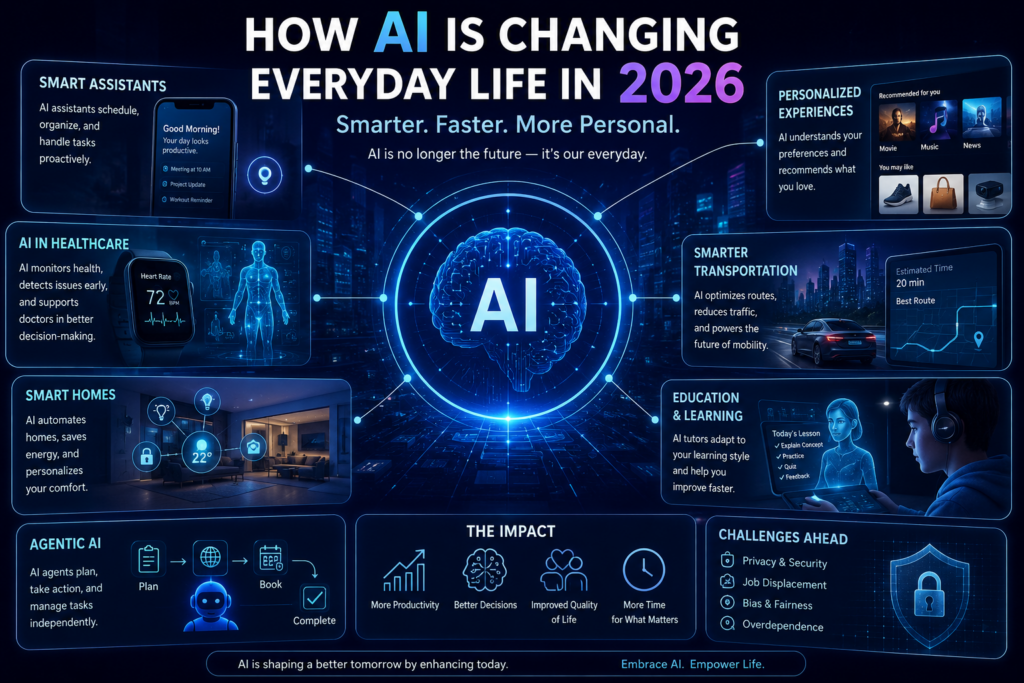
Artificial intelligence is no longer something people only notice in chatbots or futuristic demos. In 2026, AI has become part of ordinary life — quietly shaping how people work, shop, travel, communicate, study, and even make decisions. The biggest shift is not that AI suddenly became visible everywhere; it’s that it became invisible infrastructure integrated into daily routines.
Smarter Personal Assistants and Daily Productivity
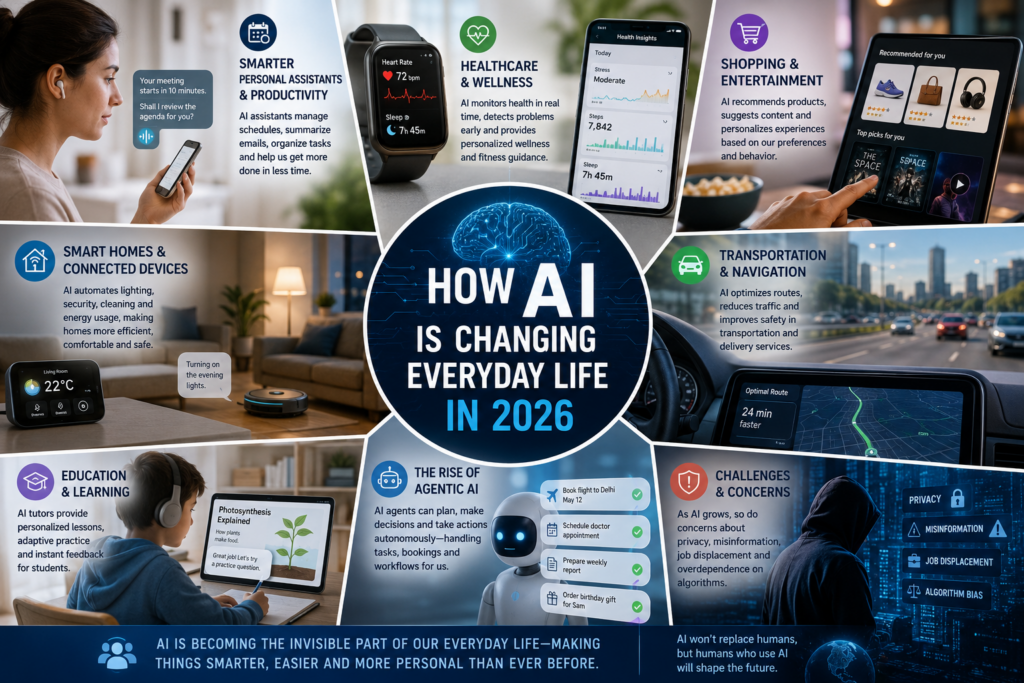
AI assistants in 2026 do far more than answer questions. They manage schedules, summarize emails, organize files, generate reports, and automate repetitive tasks. Many systems now act proactively, suggesting actions before users even ask.
Modern AI tools are embedded directly into phones, browsers, and operating systems. Instead of switching between apps, users interact naturally with AI through voice, text, and images. This has changed how people search for information, write content, and manage their time.
AI in Healthcare and Wellness
Healthcare has become one of the most important areas transformed by AI. Smartwatches and health apps now monitor sleep, heart rate, stress, and physical activity in real time. AI systems help detect abnormalities earlier and assist doctors with diagnosis and patient prioritization.
AI-powered wellness tools also provide personalized fitness advice, nutrition tracking, and mental health support. Some wearable devices even use predictive analysis to warn users about possible health issues before symptoms appear.
Shopping, Entertainment, and Personalized Experiences
Online shopping has become highly personalized through AI. Instead of manually searching through hundreds of products, users receive tailored recommendations based on preferences, habits, and previous behavior. AI tools now help compare products, summarize reviews, and predict what customers may want next.
Streaming platforms, music apps, and social media also rely heavily on AI recommendation systems. Entertainment is becoming more customized, with AI suggesting movies, songs, articles, and even personalized content creation tools for users.
Smarter Homes and Connected Devices
Smart homes in 2026 use AI to automate lighting, energy usage, cleaning, and security. AI-powered refrigerators suggest meals based on available ingredients, robot vacuums learn room layouts, and home assistants understand conversational commands more naturally.
This shift has made technology feel less mechanical and more adaptive. Many devices now learn routines automatically and adjust settings without requiring constant user input.
Transportation and Navigation
AI continues to improve transportation systems by optimizing traffic flow, navigation, and route planning. Navigation apps now analyze driving patterns, weather conditions, and real-time traffic data to recommend efficient routes.
Autonomous and semi-autonomous technologies are also expanding in logistics, delivery services, and warehouse operations. While fully self-driving cars are still developing, AI-assisted transportation has already become common in many industries.
Education and Learning
Education is becoming more personalized through AI tutors and adaptive learning platforms. Students receive customized lessons based on their learning speed, strengths, and weaknesses. AI can instantly explain concepts, generate practice exercises, and provide feedback.
Teachers also use AI tools for grading, lesson planning, and administrative tasks, allowing more focus on direct student interaction.
The Rise of Agentic AI
One of the biggest developments in 2026 is “agentic AI” — systems capable of taking actions independently rather than simply responding to prompts. These AI agents can plan tasks, manage workflows, book appointments, and coordinate activities across multiple platforms.
This marks a shift from AI as a passive assistant to AI as an active collaborator. Businesses and individuals are increasingly restructuring workflows around these systems.
Challenges and Concerns
Despite the benefits, AI’s rapid growth raises concerns about privacy, misinformation, job displacement, and overdependence on algorithms. Experts continue debating how to balance innovation with regulation and human oversight.
Many people are also becoming more aware of how AI shapes choices through recommendation systems and personalized feeds. The discussion is shifting from “Can AI do this?” to “How much influence should AI have?”
Conclusion
In 2026, AI is changing everyday life not through dramatic robots or science-fiction scenarios, but through constant small improvements woven into ordinary experiences. From healthcare and education to shopping and communication, AI is becoming a background layer that helps people save time, make decisions, and automate routine tasks.