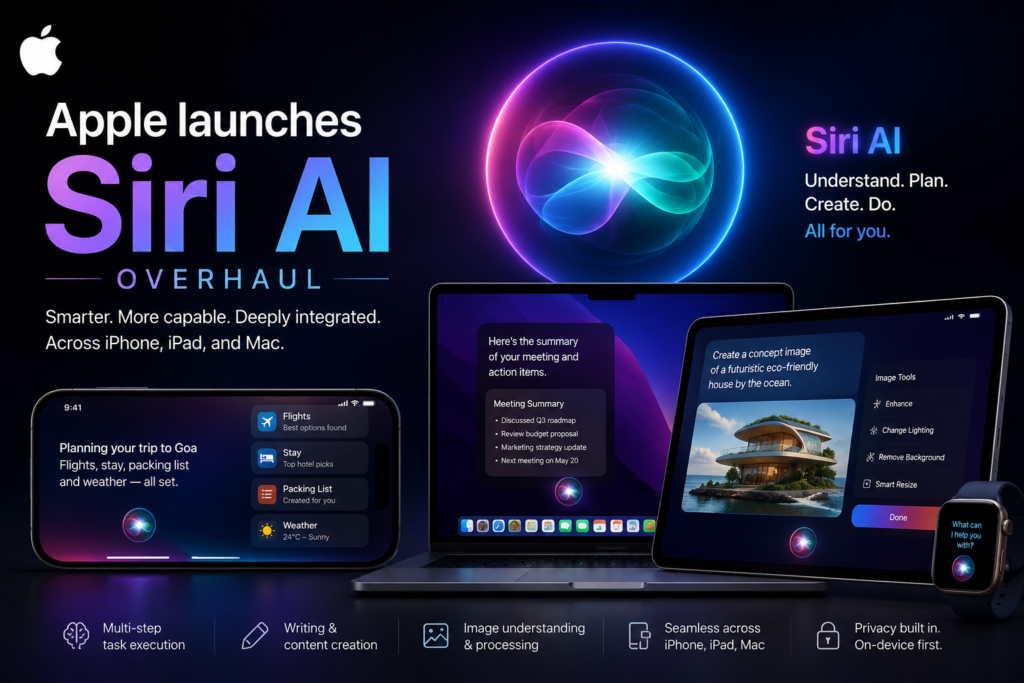
Apple has introduced one of its most significant software upgrades in years: a major transformation of Siri into a next-generation system called Siri AI. This upgrade moves Siri beyond simple voice commands and into a full generative AI assistant capable of handling complex, multi-step tasks across iPhone, iPad, and Mac ecosystems.
The announcement signals Apple’s push to compete more directly in the rapidly evolving AI landscape, where assistants are no longer just reactive tools but proactive digital collaborators. Siri AI is designed to understand context, plan actions, generate content, and even process images—all while staying tightly integrated into Apple’s ecosystem.
A Smarter Siri Built for the Generative AI Era


Siri has long been known as one of the earliest mainstream voice assistants, but it has often lagged behind newer AI systems in flexibility and reasoning. With Siri AI, Apple is repositioning the assistant as a multimodal intelligence layer that can understand text, voice, and visual inputs simultaneously.
At its core, Siri AI is powered by advanced generative models that allow it to:
- Interpret complex, multi-step instructions
- Generate human-like written responses
- Summarize documents and emails
- Create structured plans (travel, work, study schedules)
- Analyze and edit images directly on-device or via secure cloud processing
Instead of responding to isolated commands like “set a reminder” or “play music,” Siri AI can now handle requests such as:
“Plan a 3-day trip to Goa, book suitable flights, create a packing list, and summarize weather conditions.”
This shift represents a major conceptual leap from assistant to task executor and planner.
Deep Integration Across iPhone, iPad, and Mac


One of the most important aspects of Siri AI is its deep integration across Apple devices. Rather than functioning as a standalone assistant, Siri AI operates as a system-wide intelligence layer embedded in iOS, iPadOS, and macOS.
Cross-Device Continuity
Users can start a task on one device and continue it on another seamlessly. For example:
- Draft an email on iPhone
- Let Siri AI refine and format it on Mac
- Use iPad for visual attachments or image editing
Context Awareness
Siri AI remembers context across apps and sessions. If a user is planning a trip, it can:
- Pull details from Messages
- Extract dates from Calendar
- Suggest hotels from Safari browsing history
- Cross-check budget notes in Reminders
This contextual awareness eliminates repetitive input and reduces the need for switching between apps.
Multi-Step Task Execution: From Assistant to Agent
Siri AI is designed not just to respond, but to execute workflows autonomously.
Example: Planning a Business Meeting
A user might say:
“Arrange a client meeting next week, find a suitable time, send invites, and prepare a summary of our last discussion.”
Siri AI can:
- Analyze calendar availability
- Suggest optimal time slots
- Draft and send invitations
- Pull relevant notes from past emails
- Generate a meeting brief
This transforms Siri into what Apple describes as a “personal task agent” rather than a simple assistant.
Example: Content Creation
Siri AI can also assist with writing and creative tasks:
- Writing blog posts
- Drafting professional emails
- Creating presentation outlines
- Generating summaries from long documents
It bridges productivity and creativity in a unified interface.
Image Understanding and Visual Intelligence


One of the most powerful additions in Siri AI is its image processing capability. Users can now interact with visual content in natural language.
Key capabilities include:
- Identifying objects in photos
- Editing images using voice commands
- Removing or replacing backgrounds
- Enhancing lighting and resolution
- Extracting text from images and converting it into editable formats
For example, a user could say:
“Remove the background from this photo and make it look like a studio portrait.”
Or:
“Summarize the text in this screenshot and save it as notes.”
This makes Siri AI a bridge between computer vision and everyday usability.
On-Device Intelligence and Privacy Focus
Apple has emphasized that Siri AI is built with its long-standing privacy principles in mind. Much of the processing is handled on-device, reducing reliance on cloud servers.
Key privacy features:
- On-device AI inference for common tasks
- Encrypted cloud processing for complex requests
- No persistent storage of personal conversations
- App-level permission control for data access
This approach differentiates Apple from competitors that rely heavily on centralized cloud AI systems.
Apple’s goal is to ensure that AI intelligence does not come at the cost of user privacy, a principle that has become a core part of its branding.
Productivity Revolution Across Apps
Siri AI is deeply embedded across Apple’s native applications:
Messages and Mail
- Auto-replies generated based on conversation context
- Smart email summarization
- Tone adjustment (formal, casual, concise)
Notes and Reminders
- Automatic task extraction from text
- Smart categorization of notes
- Deadline suggestions based on content
Safari
- Web page summarization
- Contextual Q&A from articles
- Research assistance for students and professionals
Photos
- Intelligent album creation
- AI-powered search (“find photos of beaches at sunset”)
- Automatic editing suggestions
Together, these features make Siri AI a universal productivity layer across the Apple ecosystem.
Competing in the Global AI Race
The introduction of Siri AI positions Apple more aggressively against AI systems from major technology competitors. While others have focused on standalone chatbots, Apple’s strategy emphasizes ecosystem integration and user experience continuity.
Instead of treating AI as a separate product, Apple has embedded it into the core operating systems of its devices.
This approach could give Apple a unique advantage:
- Millions of users already in the Apple ecosystem
- Tight hardware-software optimization
- Strong privacy reputation
- Seamless device integration
However, the challenge remains whether Siri AI can match or exceed the raw reasoning capabilities of other advanced AI models in the market.
Real-World Use Cases
Siri AI is designed to fit into everyday life scenarios:
For Students
- Summarizing textbooks
- Creating study schedules
- Explaining complex topics in simpler language
For Professionals
- Drafting reports
- Managing meetings
- Automating email responses
For Creators
- Generating content ideas
- Editing visuals
- Structuring scripts or videos
For Everyday Users
- Planning travel
- Managing personal budgets
- Organizing daily routines
Its versatility makes it less of a “tool” and more of a personal digital companion.
Limitations and Challenges Ahead
Despite its promise, Siri AI faces several challenges:
1. Complexity of Real-World Tasks
Multi-step reasoning still has limitations, especially in unpredictable contexts.
2. Dependence on Data Quality
Accurate responses depend heavily on structured and updated data sources.
3. User Trust
Users may need time to trust an AI system that takes autonomous actions like sending emails or booking appointments.
4. Performance Trade-offs
Balancing on-device processing with battery efficiency remains a technical challenge.
Apple will need to continuously refine Siri AI to maintain reliability at scale.
The Future of Siri AI
Looking ahead, Siri AI is expected to evolve into an even more autonomous system. Potential future enhancements could include:
- Real-time AR assistance using Apple Vision technologies
- Proactive suggestions before users ask
- Full automation of daily workflows
- Advanced emotional and conversational understanding
- Deeper integration with third-party apps
The long-term vision appears to be a fully intelligent operating system layer that anticipates user needs before they are expressed.
Conclusion
The launch of Siri AI marks a defining moment in Apple’s AI journey. By transforming Siri from a basic voice assistant into a powerful generative AI system, Apple is redefining how users interact with their devices.
Rather than simply responding to commands, Siri AI can now think in workflows, generate content, understand images, and coordinate actions across multiple devices.
If successful, this evolution could turn Siri AI into one of the most widely used AI systems in the world—not by existing as a separate app, but by becoming an invisible, intelligent layer embedded into everyday digital life.
The future Apple envisions is clear: AI that doesn’t just answer you—but works with you.