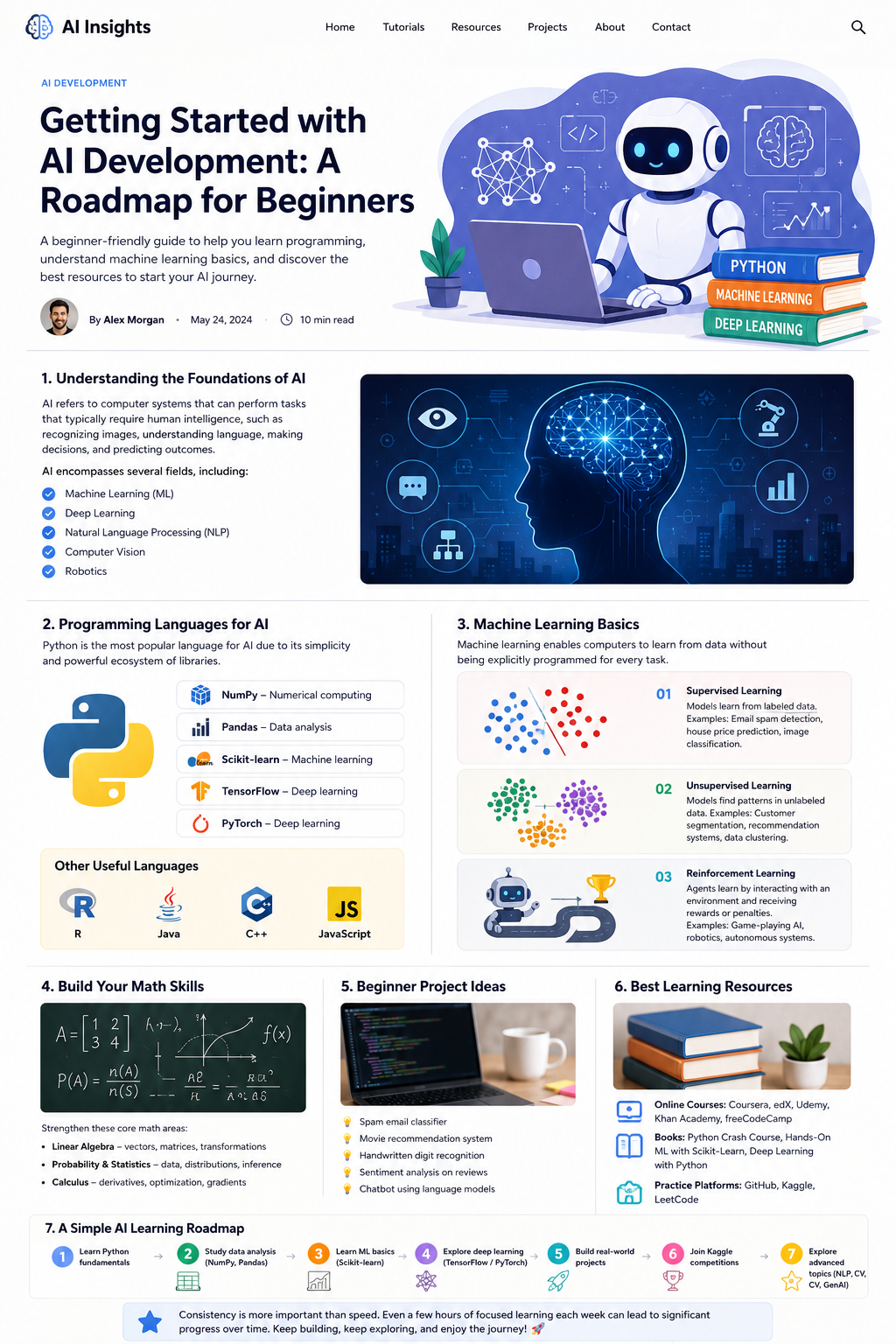
Artificial Intelligence (AI) is transforming industries ranging from healthcare and finance to education and entertainment. For beginners, entering the world of AI can seem overwhelming, but with the right roadmap, anyone can build a strong foundation and start creating intelligent applications. This guide introduces essential programming languages, machine learning fundamentals, and valuable learning resources to help you begin your AI development journey.
Understanding the Foundations of AI
Before diving into development, it’s important to understand what AI is. AI refers to computer systems that can perform tasks that typically require human intelligence, such as recognizing images, understanding language, making decisions, and predicting outcomes.
AI encompasses several fields, including:
- Machine Learning (ML)
- Deep Learning
- Natural Language Processing (NLP)
- Computer Vision
- Robotics
Most beginners start with machine learning because it serves as the foundation for many AI applications.
Learning the Right Programming Languages
Programming is an essential skill for AI development. While several languages can be used, some are more beginner-friendly and widely adopted.
Python: The Top Choice for AI
Python is the most popular programming language in AI due to its simplicity and extensive ecosystem of libraries. Key AI-related libraries include:
- NumPy for numerical computing
- Pandas for data analysis
- Matplotlib for visualization
- Scikit-learn for machine learning
- TensorFlow and PyTorch for deep learning
Python’s readable syntax makes it ideal for beginners.
Other Useful Languages
Although Python dominates AI development, other languages can be valuable:
- R: Popular for statistics and data science.
- Java: Common in enterprise applications.
- C++: Useful for performance-critical AI systems.
- JavaScript: Increasingly used for AI applications in web browsers.
Understanding Machine Learning Basics
Machine learning enables computers to learn from data without being explicitly programmed for every task.
Types of Machine Learning
Supervised Learning
In supervised learning, models learn from labeled data. Examples include:
- Email spam detection
- House price prediction
- Image classification
Unsupervised Learning
Unsupervised learning finds patterns in unlabeled data. Common applications include:
- Customer segmentation
- Recommendation systems
- Data clustering
Reinforcement Learning
Reinforcement learning trains agents to make decisions through rewards and penalties. It is commonly used in:
- Game-playing AI
- Robotics
- Autonomous systems
Key Concepts to Learn
Beginners should focus on understanding:
- Datasets and data preprocessing
- Features and labels
- Training and testing data
- Model evaluation
- Overfitting and underfitting
- Accuracy, precision, and recall
These concepts form the backbone of practical machine learning.
Building Essential Math Skills
AI relies heavily on mathematics. While you don’t need advanced expertise initially, familiarity with these topics helps:
Linear Algebra
Used for handling vectors, matrices, and neural network computations.
Probability and Statistics
Important for understanding predictions, uncertainty, and model evaluation.
Calculus
Helpful for understanding optimization and how neural networks learn.
Many AI learners study these topics alongside practical coding projects.
Hands-On Projects for Beginners
The best way to learn AI is through practice. Consider starting with simple projects such as:
- Spam email classifier
- Movie recommendation system
- Handwritten digit recognition
- Sentiment analysis on product reviews
- Chatbots using language models
Building projects helps reinforce concepts and creates a portfolio for future opportunities.
Recommended Learning Resources
Online Courses
Popular learning platforms include:
- Coursera
- edX
- Udemy
- Khan Academy
- freeCodeCamp
These platforms offer beginner-friendly courses on programming, data science, and machine learning.
Books
Recommended beginner books include:
- Python Crash Course by Eric Matthes
- Hands-On Machine Learning with Scikit-Learn, Keras, and TensorFlow by Aurélien Géron
- Deep Learning with Python by François Chollet
Practice Platforms
To improve coding and AI skills, explore:
- GitHub for open-source projects
- Kaggle for datasets and competitions
- LeetCode for programming practice
Creating a Long-Term Learning Plan
A practical AI learning roadmap might look like this:
- Learn Python fundamentals.
- Study data analysis with NumPy and Pandas.
- Learn machine learning basics with Scikit-learn.
- Explore deep learning using TensorFlow or PyTorch.
- Build real-world projects.
- Participate in Kaggle competitions.
- Study advanced topics such as NLP, computer vision, and generative AI.
Consistency is more important than speed. Even a few hours of focused learning each week can lead to significant progress over time.
Conclusion
AI development offers exciting opportunities for beginners willing to learn programming, mathematics, and machine learning fundamentals. Starting with Python, understanding core machine learning concepts, and working on hands-on projects provide a strong foundation for growth. By leveraging high-quality learning resources and maintaining a structured learning path, aspiring developers can steadily progress from beginner to capable AI practitioner and contribute to the rapidly evolving field of artificial intelligence.