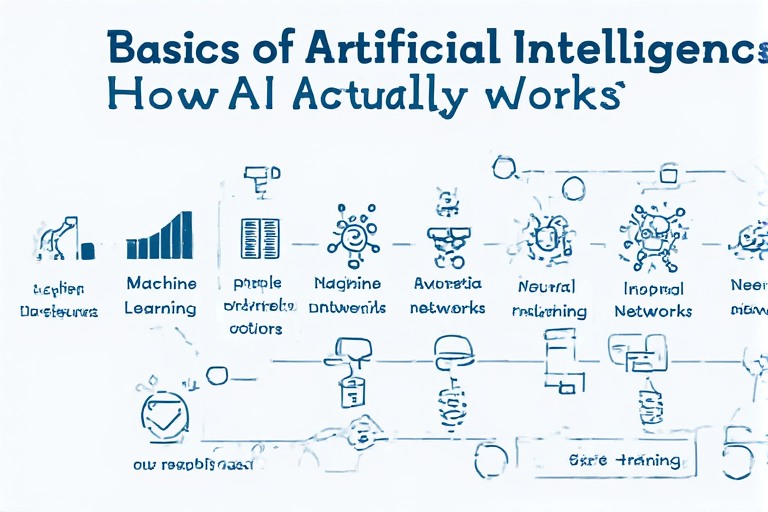
Artificial Intelligence (AI) often sounds complex and futuristic, but at its core, it’s about teaching machines to recognize patterns, learn from data, and make decisions in a way that mimics human intelligence. To understand how AI really works, it helps to break it down into a few key ideas: machine learning, neural networks, and data training.
What is Artificial Intelligence?
Artificial Intelligence is a branch of computer science that focuses on building systems capable of performing tasks that usually require human intelligence. These tasks include:
- Recognizing images and faces
- Understanding language
- Making predictions
- Playing games
- Recommending content (like videos or products)
Instead of being explicitly programmed for every action, AI systems learn from experience.
Machine Learning: The Heart of Modern AI
Machine Learning (ML) is the most important part of today’s AI systems. It allows computers to learn patterns from data without being directly programmed.
How it works in simple terms:
- You give the system data (examples)
- The system looks for patterns
- It learns from those patterns
- It makes predictions or decisions on new data
For example, if you show a machine thousands of cat and dog pictures, it gradually learns the difference between them.
There are three common types of machine learning:
- Supervised Learning: Learning from labeled data (e.g., “this is a cat”)
- Unsupervised Learning: Finding hidden patterns in unlabeled data
- Reinforcement Learning: Learning through trial and error (like training a game-playing AI)
Data Training: How AI Learns
Data is the fuel of AI. Without data, AI cannot learn anything.
The training process:
- Collect large amounts of data
- Clean and organize the data
- Feed it into the AI model
- Adjust the model when it makes mistakes
- Repeat until it improves
Think of it like teaching a child: the more examples they see, the better they understand.
For instance, a spam email filter is trained using thousands of emails labeled as “spam” or “not spam.”
Neural Networks: The Brain-Inspired System
Neural networks are a type of machine learning model inspired by the human brain.
They are made up of layers:
- Input layer: Receives raw data
- Hidden layers: Process and analyze patterns
- Output layer: Produces the final result
Each connection between “neurons” has a weight, which adjusts as the system learns.
Simple idea:
Neural networks don’t “think” like humans, but they process information in a layered way that helps them recognize complex patterns like faces, speech, or handwriting.
How AI Actually Works Together
Here’s how everything fits:
- Data is collected
- Machine learning algorithms process the data
- Neural networks help identify patterns
- The model is trained and improved over time
- The AI makes predictions or decisions on new information
For example, when you use a voice assistant:
- Your voice is converted into data
- AI analyzes the sound patterns
- It predicts what you said
- It responds with the best answer
Real-World Examples of AI
AI is already part of everyday life:
- Search engines predicting what you type
- Streaming platforms recommending movies
- Smartphones recognizing faces
- Online maps finding the fastest routes
- Chatbots answering customer questions
You interact with AI more often than you might realize.
Conclusion
Artificial Intelligence is not magic—it is a combination of data, learning algorithms, and neural networks working together. Machine learning helps systems learn from experience, data training improves accuracy, and neural networks allow AI to recognize complex patterns.
As technology continues to evolve, AI will become even more integrated into daily life, making systems smarter, faster, and more helpful.