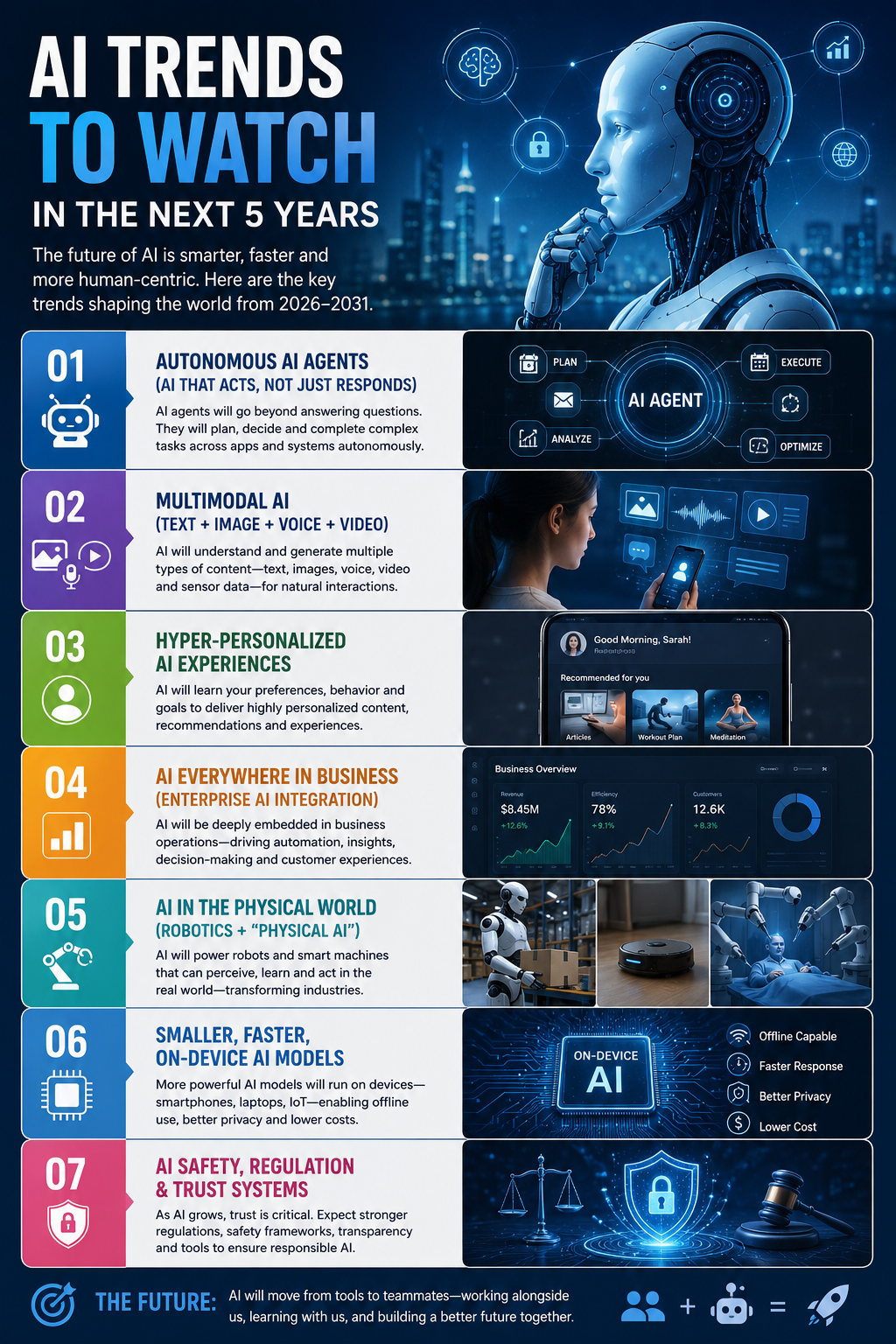
Artificial Intelligence is moving from experimental tools to core infrastructure powering businesses, devices, and everyday life. Over the next five years, we’ll see AI become more autonomous, multimodal, personalized, and physically integrated into the real world .
Below is a clear breakdown of the most important AI trends shaping the near future.
1. Autonomous AI Agents (AI that acts, not just responds)


5
AI is shifting from chat-based tools to autonomous agents that can complete full tasks like booking travel, writing reports, managing workflows, or even running business processes.
Instead of answering questions, these systems will:
- Break goals into steps
- Execute tasks across apps
- Learn from outcomes
This “agentic AI” shift is considered one of the biggest platform changes in AI history .
2. Multimodal AI (Text + Image + Voice + Video together)


8
Future AI won’t be limited to text. It will understand and generate:
- Speech
- Images
- Video
- Sensor data
For example, you could show a broken product, speak a question, and get a visual + spoken solution instantly.
This makes AI far more natural and human-like in interaction.
3. Hyper-Personalized AI Experiences


6
AI will deeply customize everything:
- News feeds
- Shopping experiences
- Education paths
- Health tracking
Instead of “one-size-fits-all,” every user will have a unique AI experience tailored to their behavior and preferences.
This will make apps feel more like “personal assistants” than software.
4. AI Everywhere in Business (Enterprise AI integration)


6
Companies are rapidly embedding AI into core operations like:
- Finance and accounting
- Supply chain planning
- Customer service
- Marketing automation
AI is becoming a built-in layer of software, not a separate tool.
Most organizations will treat AI as infrastructure, similar to electricity or cloud computing .
5. AI in the Physical World (Robotics + “Physical AI”)


7
A major shift is happening: AI is leaving screens and entering the real world.
Expect growth in:
- Warehouse robots
- Household assistants
- Healthcare robotics
- Smart factories
These systems learn tasks through interaction instead of strict programming .
6. Smaller, Faster, On-Device AI Models


7
Not all AI will live in the cloud.
We’ll see:
- AI running on phones and laptops
- Faster responses with no internet
- Better privacy
- Lower costs
This will make AI tools more accessible globally, especially in regions with limited connectivity.
7. AI Safety, Regulation, and Trust Systems


6
As AI becomes more powerful, governments and companies are focusing on:
- AI regulations
- Content authenticity (deepfake detection)
- Data privacy
- Security and risk control
Trust will become a key competitive advantage in AI systems.
Conclusion
The next five years of AI will be defined by a major shift from tools → agents → ecosystems → real-world systems.
We’re moving toward a world where:
- AI handles tasks independently
- Devices understand multiple forms of input
- Personalization becomes default
- Robots assist in physical environments
- AI becomes deeply embedded in everything digital
In short: AI will stop being something you “use” and start becoming something that quietly “runs the background of life.”