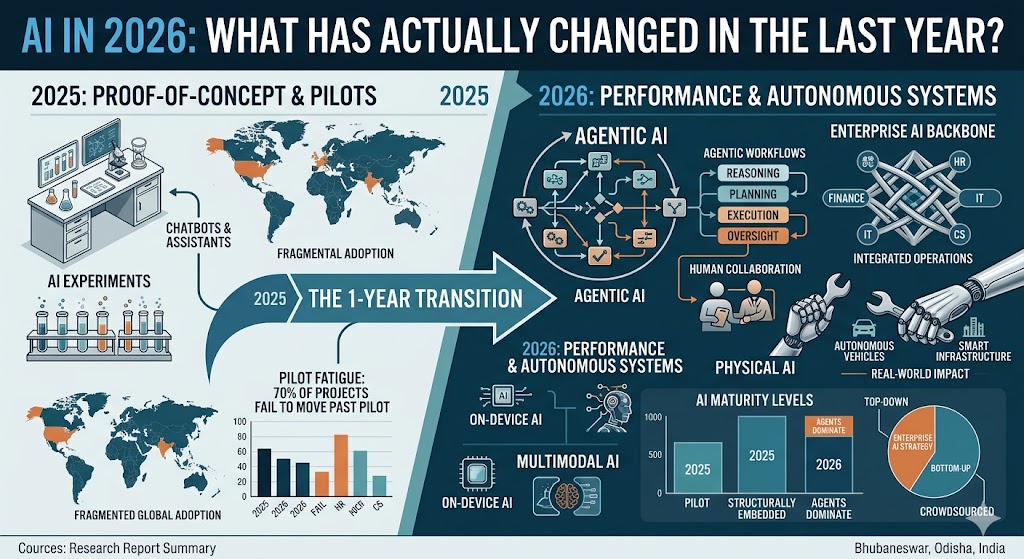
AI in 2026 has shifted from chatbots to autonomous agents, multimodal systems, and embedded “invisible AI.” It now powers real workflows, coding, and business systems as core infrastructure.
Artificial intelligence in 2026 looks less like a “new technology” and more like infrastructure—something quietly embedded into everyday software, workflows, and decision-making systems. Compared to 2025, the shift hasn’t been about one breakthrough model. It has been about how AI is used, how it acts, and where it is embedded.
Below is a detailed breakdown of what actually changed in the last year, with real industry trends and practical implications.
1. From Chatbots to AI Agents That Do Real Work


7
The biggest shift in 2026 is the maturity of AI agents—systems that don’t just respond, but execute tasks across tools and platforms.
In 2025, agents were still experimental in many organizations. By 2026, they are increasingly treated as “digital workers” that can:
- Book meetings and manage calendars
- Write, test, and deploy code
- Run marketing workflows end-to-end
- Connect APIs and software tools automatically
This transition is widely described as moving from “answers to actions” or from copilots to execution systems .
The key change isn’t capability alone—it’s reliability. Enterprises are no longer asking “can AI do this?” but “can we trust it to complete this workflow consistently?”
However, adoption is still uneven. Companies are combining AI agents with deterministic software to reduce errors, especially in high-stakes environments .
2. Multimodal AI Became the Default, Not a Feature


6
A major change in the last year is that AI is no longer “text-first.”
By 2026, leading systems routinely handle:
- Text + images together
- Video understanding and generation
- Voice interaction with real-time context
- Mixed inputs like documents, screenshots, and code
What used to be considered “advanced multimodal AI” is now a baseline expectation in enterprise and consumer tools.
This shift matters because it changes how people interact with AI:
- Users no longer describe everything in text
- AI can “see” interfaces and interpret screens
- Workflows are increasingly visual and interactive
In practice, this is making AI feel less like chat software and more like an operating layer across apps.
3. AI Is Moving from General Models to Specialized Systems


4
Another important shift is the move away from one-size-fits-all models.
Instead of relying only on massive general-purpose models, 2026 is seeing growth in:
- Healthcare-specific AI systems
- Legal and compliance-focused models
- Finance and risk models tuned for regulation
- Industry-specific copilots embedded in tools
This reflects a broader trend: specialized AI is more reliable than general AI for real-world work.
A growing share of enterprise deployments now use domain-tuned models or hybrid systems rather than purely general chat models .
This is also helping solve two long-standing problems:
- Hallucinations (incorrect outputs)
- Lack of domain accountability
4. “Invisible AI” Is Replacing Chat Interfaces


6
One of the most subtle but important changes is that AI is becoming less visible.
Instead of opening a chatbot, users increasingly experience AI through:
- Smart recommendations (shopping, content, navigation)
- Background automation (email sorting, scheduling)
- Embedded assistants inside apps
- Predictive actions (before the user asks)
This is often called “invisible intelligence.”
The implication is significant: AI is no longer a destination tool—it’s becoming part of every digital surface.
5. AI Coding and Software Development Became Mainstream


6
In 2026, AI-assisted coding is no longer experimental.
Developers now routinely use AI to:
- Generate production-ready code
- Debug complex systems
- Refactor large codebases
- Write tests and documentation
The important change is not just speed—it’s shift in role:
Developers are moving from writing every line to supervising AI-generated systems.
This is accelerating software production, but also increasing the need for:
- Strong review processes
- Security validation
- AI-aware engineering practices
6. AI Is Now an Economic and Infrastructure Layer


7
Perhaps the most important shift is structural: AI is no longer just software—it is infrastructure.
In 2026:
- AI development is tightly linked to compute power and chips
- Companies are building “AI factories” at massive scale
- Energy and hardware constraints influence AI progress
- Enterprises are investing in AI governance and infrastructure control
AI supercomputing capacity and cost continue to scale rapidly, reinforcing the idea that AI is now a capital-intensive industrial system, not just a software field .
7. Security, Trust, and Regulation Became Central


7
As AI becomes more autonomous, concerns have shifted from capability to control.
Key 2026 concerns include:
- AI systems making unauthorized decisions
- Data leakage through autonomous tools
- Model misuse in cyberattacks
- Lack of transparency in agent behavior
Security research shows AI systems are rapidly improving in cybersecurity tasks—but this also means attackers are using them more effectively .
As a result, organizations are investing heavily in:
- AI auditing
- Access control for agents
- Monitoring and logging of AI actions
- Governance frameworks
8. The Big Shift: From “AI Tools” to “AI Systems”
If there is one way to summarize 2026, it is this:
AI is no longer a tool you use. It is a system you deploy.
In 2025:
- AI = assistant (chat-based help)
- Focus = better responses
In 2026:
- AI = worker + infrastructure layer
- Focus = execution, integration, reliability
This explains why progress feels less like flashy demos and more like deep integration into work, software, and business processes.
What This Means for Users and Businesses
For individuals:
- Expect AI in everything you already use (not separate apps)
- Learn to supervise AI rather than just prompt it
- Expect faster automation of routine tasks
For businesses:
- Competitive advantage shifts to AI integration, not just adoption
- Data quality and workflow design matter more than model choice
- Governance becomes as important as innovation
For developers:
- AI orchestration is becoming a core skill
- Debugging and verifying AI output is critical
- “Agent design” is emerging as a new engineering discipline
Conclusion
AI in 2026 is not defined by a single breakthrough model—it is defined by maturity and embedding.
The biggest changes in the last year are:
- AI agents moving from experiments to real workers
- Multimodal AI becoming standard
- Specialized models replacing general-only systems
- AI disappearing into everyday software
- Infrastructure and governance becoming central
In short, AI is no longer “arriving.” It is now everywhere—and the real challenge has shifted from building AI to managing how it behaves in the real world.