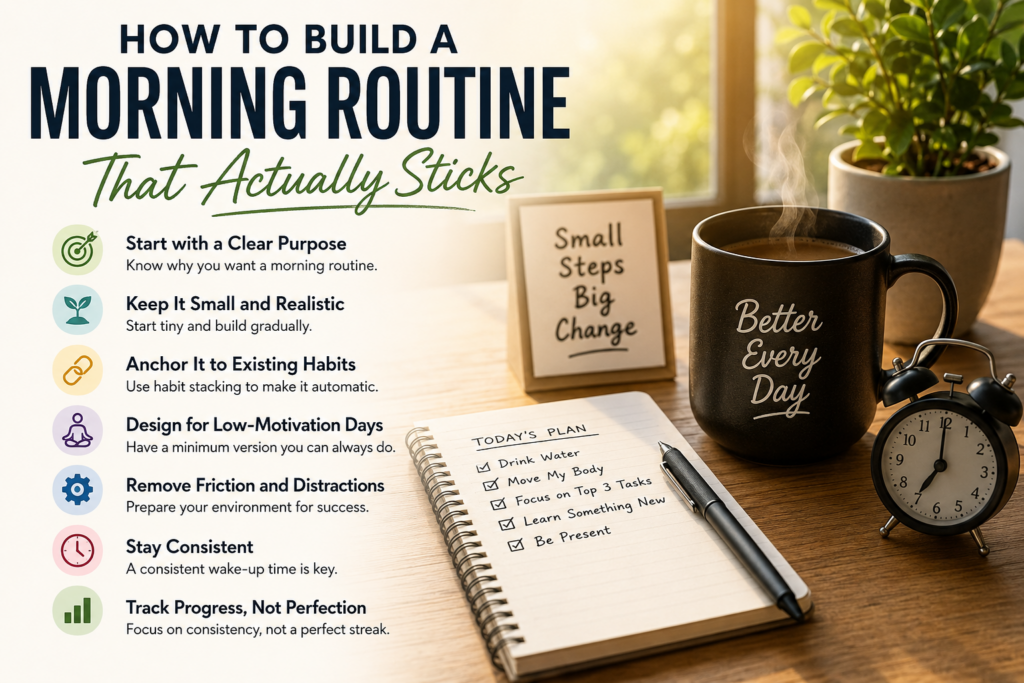
A good morning routine can set the tone for your entire day. It can improve focus, boost energy, and reduce stress. Yet, most people struggle to maintain one for more than a few days. The problem is not usually motivation—it’s structure. A routine that sticks is simple, realistic, and designed around your actual life, not an ideal version of it.
Below is a practical guide to building a morning routine that you can actually sustain.
Start with a Clear Purpose
Before choosing what to include in your morning routine, define why you want one. Many people fail because they copy routines they see online without thinking about their own needs.
Ask yourself:
- Do I want more productivity?
- Better mental clarity?
- Improved health or fitness?
- Less morning stress?
Your purpose will shape your choices. For example, if your goal is mental clarity, meditation or journaling might matter more than an intense workout. If your goal is physical health, exercise and a nutritious breakfast may take priority.
Without purpose, your routine becomes random—and random routines don’t last.
Keep It Small and Realistic
One of the biggest mistakes is trying to do too much too soon. A 2-hour morning routine sounds impressive but is rarely sustainable.
Instead, start with something small—something you can do even on your worst day.
A simple structure might look like:
- Drink water
- Stretch for 5 minutes
- Plan your top 3 tasks for the day
That’s it. Once this becomes automatic, you can slowly add more steps.
Consistency matters far more than complexity. A short routine done daily is more powerful than a perfect routine done occasionally.
Anchor Your Routine to an Existing Habit
Habits stick better when they are attached to something you already do. This is called “habit stacking.”
For example:
- After brushing your teeth → drink a glass of water
- After making your bed → do 5 minutes of stretching
- After making coffee → write your daily priorities
By linking new habits to existing ones, you reduce the mental effort needed to remember them. Over time, the sequence becomes automatic.
Design for Low-Motivation Days
Most routines fail because they only work on good days. A strong routine is one that survives bad days too.
Ask yourself:
“What is the minimum version of this routine I can still do when I feel tired or unmotivated?”
For example:
- Full routine: 30-minute workout
- Minimum version: 5 push-ups or a short walk
This approach prevents the “all-or-nothing” mindset. Even small actions maintain the habit loop, which is more important than intensity.
Remove Friction and Distractions
Your environment plays a big role in whether your routine sticks.
Make your mornings easier by:
- Keeping workout clothes ready the night before
- Placing your journal or book on your desk
- Charging your phone away from your bed
- Preparing breakfast ingredients in advance
The fewer decisions you have to make in the morning, the more likely you are to follow through. Good routines are often about reducing resistance, not increasing discipline.
Wake Up at a Consistent Time
A stable wake-up time is the backbone of any morning routine. If your wake-up time changes daily, your routine will struggle to form.
Try to wake up at the same time every day, even on weekends. This regulates your body clock and makes mornings feel more predictable.
You don’t necessarily need to wake up extremely early. What matters is consistency, not the exact hour.
Avoid Overloading Your Morning
A morning routine should energize you, not exhaust you. If you try to fit too many activities into it, you’ll eventually start skipping it.
A good rule is:
If it feels rushed, it’s too much.
Your morning should feel calm and controlled. Leave space between activities instead of stacking them tightly. Even 10–15 minutes of breathing room can make your routine feel sustainable.
Track Progress, Not Perfection
Instead of aiming for a perfect streak, focus on consistency over time. Missing a day is normal. What matters is returning to the routine quickly.
You can track progress with:
- A simple calendar checkmark
- A habit tracking app
- A notebook
Seeing your consistency visually reinforces the habit and keeps you motivated without pressure.
Final Thoughts
A morning routine that sticks is not built on discipline alone—it is built on simplicity, consistency, and realism. Start small, anchor habits to existing actions, and design your routine to survive imperfect days.
Over time, these small morning actions compound into better focus, improved mood, and a stronger sense of control over your day.